Hong Kong's Securities and Futures Commission (SFC) has approved the secondary market trading of tokenized funds for the first time, with two money market funds now enabling round-the-clock trading.
On October 26, the Hong Kong SFC approved the secondary market trading of the first batch of tokenized funds available to the public on licensed virtual asset trading platforms (VATPs). Two SFC-approved tokenized money market funds have started round-the-clock trading. This marks the first tokenized funds globally that have received regulatory approval for public offering and entry into secondary market circulation.
· 2 min read
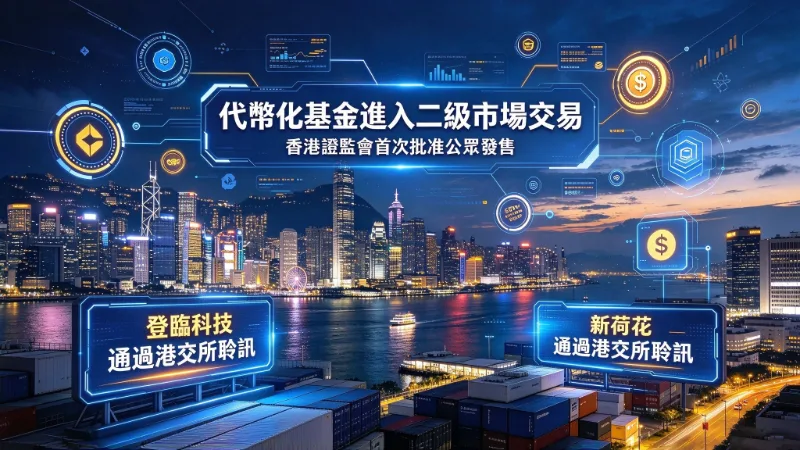
According to the Hong Kong Securities and Futures Commission's message on October 26, the Commission has approved the first batch of tokenized funds to be publicly offered for secondary market trading on licensed virtual asset trading platforms (VATPs), with two existing tokenized money market funds approved by the Commission starting 24/7 secondary market trading on October 26.
Previously, Hong Kong had completed the construction of primary issuance and subscription channels for tokenized funds, but secondary market trading had long been missing - investors lacked a compliant place to exit and transfer after subscription. This approval fills the gap in the circulation link, forming a complete "issuance - custody - secondary trading" loop for tokenized funds within Hong Kong's licensed system. The pilot stage focuses on money market funds, with underlying assets being short-term, highly liquid instruments, and the risk characteristics are relatively controllable.
Professional Analysis
The institutional significance of this approval is greater than the scale significance of a single product. Hong Kong's previous RWA development mainly focused on the issuance side (tokenized green bonds, tokenized fund subscriptions), but secondary trading has always been the weakest link in the compliance chain - without a licensed secondary market, the "liquidity premium" of tokenized assets cannot be realized. This time, including two money market funds in the VATP secondary trading is equivalent to opening a regulated exit and pricing window for tokenized funds.
But what needs to be calmly considered is that the pilot is still in its early stages: the targets are limited to money market funds, which have the highest standardization and the lowest volatility; liquidity depth, cross-platform pricing efficiency, and investor suitability management (whether the trading of tokenized funds on VATPs forms arbitrage or fragmentation with traditional fund subscriptions) all require continuous observation. For non-standard RWA such as brand assets and operating rights, the reference value of this channel lies in: the existence of a compliant secondary market is a systemic prerequisite for RWA to transition from an "issuance story" to an "investable asset" . The design of secondary circulation for non-standard RWA needs to be pushed back from the acceptability of licensed trading venues, rather than waiting for the issuance to be completed before finding a circulation outlet.